Mass-resolved laser spectroscopy of molecular aggregates and biomolecules
Principal Investigator: José A. Fernández
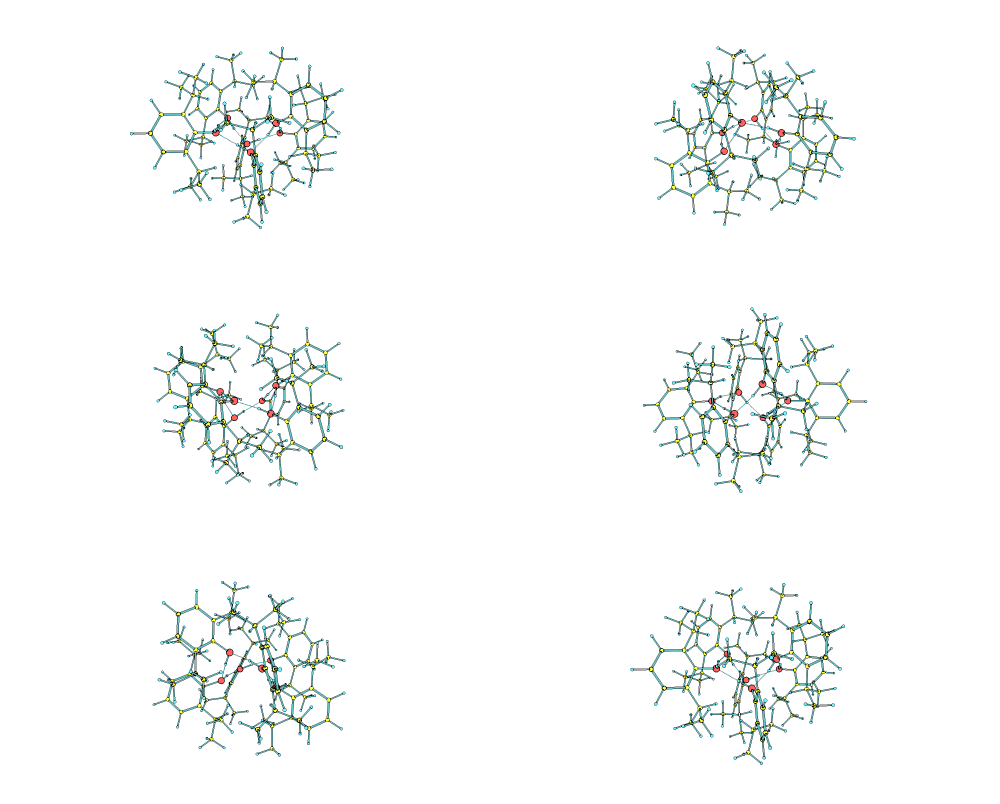
Weak interactions between molecules model the world around us. Despite their small module, they govern a variety of fundamental processes: from water condensation or formation of ice, to the ligand-receptor interaction in a cell or protein folding. The study and characterization of such interactions is of utmost importance to tackle complex phenomena like those involved in the smart design of new drugs, modelling formation of clouds or supramolecular chemistry. Due to their small strength, it is necessary to create conditions of isolation at low temperatures, that allow the molecules to aggregate without external interferences. Such conditions are achieved with the use of supersonic expansions, which create a molecular beam containing aggregates of different size. Those aggregates are then probed using a variety of spectroscopic techniques, such as 1-color and 2-color REMPI spectroscopy, IR/UV and UV/UV double resonance techniques or even more sophisticated arrangements that yield invaluable information on the structure of the aggregates. Then, the experimental information is compared with the simulations and predictions of hundreds of possible structures for the aggregates, obtained using density functional theory (DFT). The best match between theory and experiments will allow us to propose a structure for the aggregates and to obtain useful insights on the forces at play during the aggregation process.
Weak interactions between molecules model the world around us. Despite their small module, they govern a variety of fundamental processes